Project & Award: This team project (Junho Shin, Dongjae Kim, Miji Kang, Gaeun Kim) from Pukyong National University’s Data Engineering Dept. was presented at the K-Data Science (K-DS) Consortium, where it was awarded the Creative Award for the topic “Development of TRIZ-based Convergent Technology Idea Discovery Support Service”.
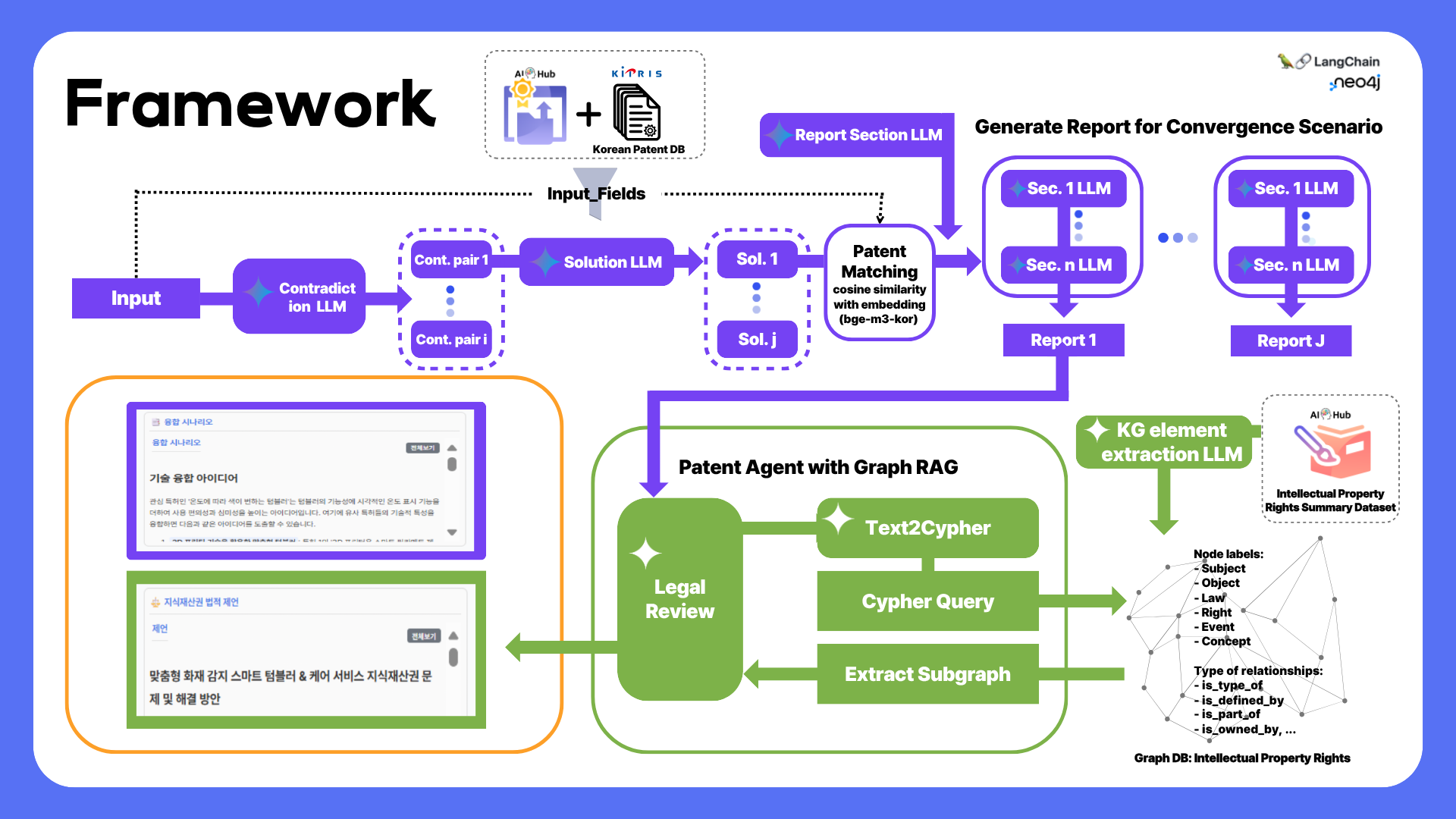
Figure 1. Framework of IPC System
Predicting where a market is heading requires understanding how discrete technologies may converge in the future. This project introduces the Intelligent Patent Convergence (IPC) service, a data-driven system for supporting technology convergence analysis and R&D ideation.
📌 The Problem: Intuition-Dependent R&D and IP Risks
Innovation rarely happens in isolation; it occurs when different technological domains collide. However, finding these convergence opportunities hidden within millions of complex patent documents is cognitively overwhelming. Traditional R&D ideation heavily relies on human intuition, leading to severe inefficiency, high costs, and high failure rates. Furthermore, blind convergence often results in unexpected Intellectual Property (IP) disputes and patent infringements.
⚙️ The Method: TRIZ, Knowledge Graphs, and LangChain
To systematically simulate viable tech convergence, we integrated the TRIZ (Theory of Inventive Problem Solving) methodology with Graph Database technology and Agentic LLM workflows:
- TRIZ Contradiction Analysis: Every technical problem involves a “contradiction” (e.g., improving strength increases weight). The system leverages TRIZ’s universally proven ‘40 Inventive Principles’ and contradiction matrix to logically deduce how different technologies can resolve each other’s weaknesses.
- Knowledge Graph Construction (Neo4j): Processed vast amounts of patent data and mapped their complex relationships (citations, inventors, technical classifications, TRIZ parameters) into a Graph Database using Neo4j.
- Graph RAG via LangChain: Replaced standard vector-based RAG with Graph RAG utilizing LangChain. This allows the LLM to retrieve interconnected concepts and structural relationships within the technology landscape.
Contribution: Simulated Scenarios & IP Defense
This system supports technology opportunity exploration and IP risk review for R&D strategy.
- Data-Driven Ideation (The ‘Smart Tumbler’ Scenario): The system demonstrated its capability by ideating a “Smart Tumbler with Enhanced Fire Detection and Burn Prevention.” It achieved this by converging distinct existing patents, specifically a fire detection pigment patent and a thermochromic design patent, into a possible product concept.
- Preemptive IP Dispute Response: The system actively analyzes patent claims to propose “avoidance designs” (e.g., altering compositions or manufacturing processes) so the new product escapes the original patent’s scope. It also provides comprehensive design guidelines to prevent copyright/trademark infringements and ensures compliance with personal information protection policies.